
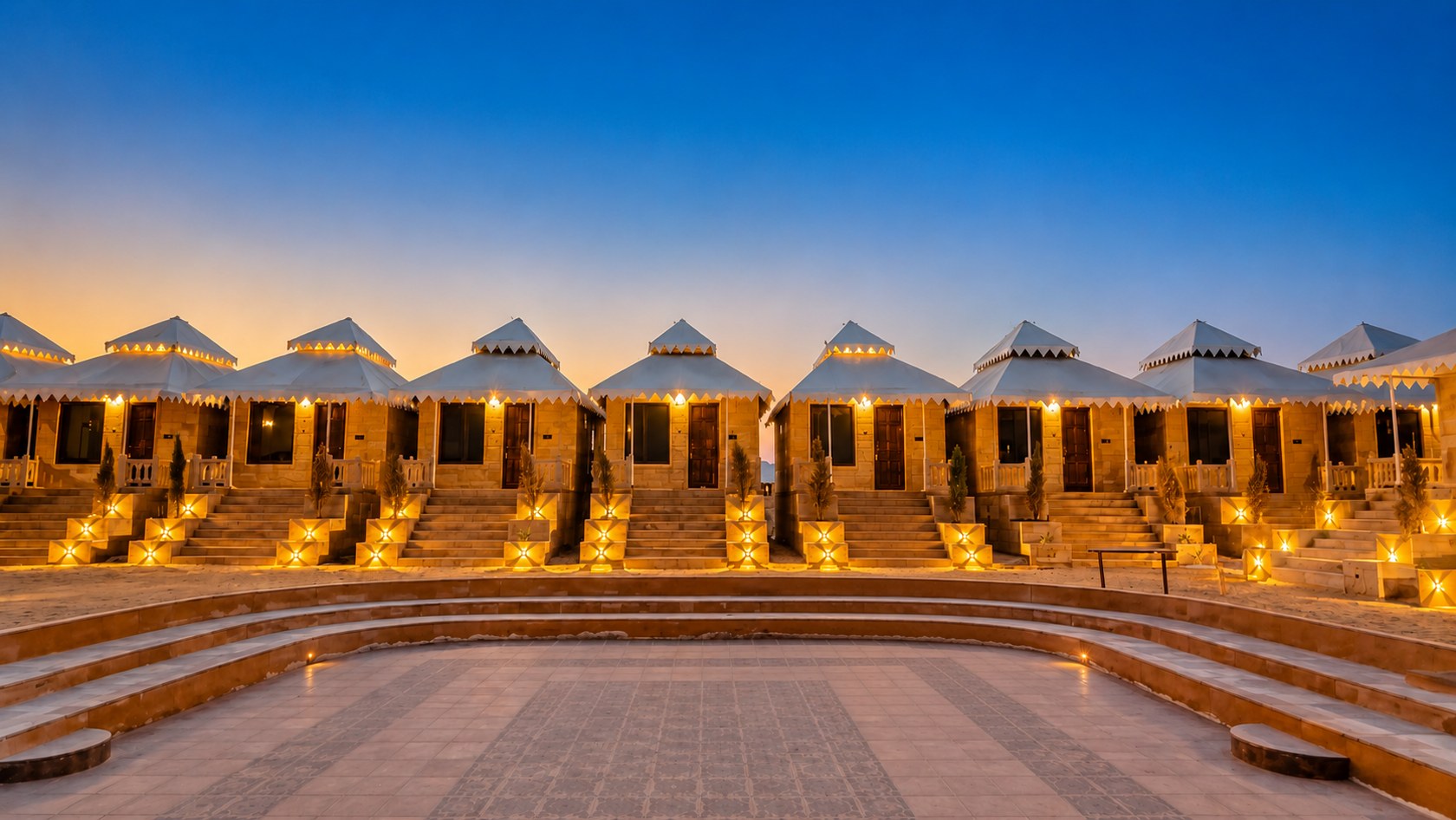
A beginner's guide to stargazing in the Thar Desert near Jaisalmer: moon phases, seasons, what to look for and phone photography tips.
Why the desert is good for stargazing
Away from cities, the Thar has dry air and little artificial light, so clear nights reveal many more stars than you will see in town. Even a short walk away from camp lights makes a noticeable difference.
Light pollution and how to escape it
Even in the desert, there is some light from camps, roads and distant towns. The glow is usually strongest on the horizon in the direction of Jaisalmer. To get the best view, walk a short distance from camp lights with a guide or companion, put a dune between you and the brightest lights, and look higher in the sky where the glow fades.
Check the moon first
The moon is the biggest factor you can plan around. A full moon lights up the dunes beautifully but hides faint stars. For the darkest skies, choose nights within a few days of the new moon, or go out after moonset.
What you can see through the year
Winter evenings (November to February)
Orion dominates the evening sky, with its three-star belt and the bright stars Betelgeuse and Rigel. Follow the belt down and to the left to find Sirius, the brightest star in the night sky. Taurus, the Pleiades cluster and Gemini are also well placed. The Milky Way is fainter in winter evenings because you are looking towards its outer edge.
Spring and summer
Later in the year the brighter central region of the Milky Way becomes visible, rising in the south. Scorpius and Sagittarius sit low over the horizon. In the desert, warm nights make it comfortable to stay out longer, though haze and dust can reduce clarity.
Planets move against the background stars, so which ones are visible depends on the date. A star-chart app will show you what is up on the night.
What to look for
- Orion and its belt on winter evenings
- The Pleiades, a small, tight cluster that looks fuzzy to the eye
- Bright planets, which shine steadily and do not twinkle
- The Milky Way on clear, moonless nights
- Satellites moving steadily across the sky soon after dusk
What you see depends on season, weather and dust. No night is guaranteed, which is part of the appeal.
Easy constellations to find
- Orion: three stars in a row form the belt, visible on winter evenings
- The Plough (Big Dipper): seven stars shaped like a ladle, useful for finding the Pole Star
- Cassiopeia: a W or M shape on the opposite side of the Pole Star from the Plough
- Scorpius: a curved tail of stars low in the south in summer
- The Pleiades: a small, tight cluster that looks like a tiny dipper
Start with one or two of these and use them as signposts to find others.
Meteors, satellites and the moon
On any clear night you are likely to see a few meteors, brief streaks of light as small particles burn up in the atmosphere. During annual meteor showers, such as the Geminids in mid-December, the rate increases, especially after midnight. Rates vary, and moonlight reduces the number you will see.
Satellites look like steady points of light gliding across the sky, most visible in the first hours after dusk. The moon itself is a rewarding target through binoculars or a telescope, especially near the half-moon phase when craters along the shadow line stand out.
How to stargaze
- Give your eyes 20–30 minutes to adapt to the dark.
- Use a red light or the dimmest phone screen setting.
- Lie back on a mat or sit in a reclining chair.
- Download a star-chart app before you lose signal.
- Binoculars show far more than the naked eye.
How dark adaptation works
Your eyes need time to adjust to darkness. In the first few minutes you will see only the brightest stars. After about 20 to 30 minutes, your pupils have widened and the sensitive cells in your eyes have adapted, revealing far fainter stars. A single glance at a bright phone screen can undo much of that, which is why red light is recommended.
Most phones have a night or red filter setting. Turn it on before you go out, and lower the brightness as far as it will go.
Using binoculars or a telescope
You do not need equipment to enjoy a desert sky, but binoculars reveal far more stars, star clusters and details on the moon. If a telescope session is offered on the night, it is a good chance to see Saturn's rings, Jupiter's moons or lunar craters up close. Telescope sessions depend on availability and weather; ask in advance.
- Let your eyes adjust to the dark before looking through a telescope
- Do not touch the eyepiece while looking; small movements blur the view
- Take turns and give each person time to find the object
- Keep phone screens dim so others keep their night vision
Useful tools to download
A star-chart app turns your phone into a map of the sky: point it upward and it labels stars, planets and constellations. Download it before you leave Jaisalmer, along with offline maps, as signal can be weak at night. A moon-phase app or calendar helps you choose dates. Weather apps that show cloud cover by the hour are useful on the day itself. Remember to switch every app to night mode, so the screen does not ruin your dark-adapted eyes.
Staying comfortable outside
Desert nights are colder than most visitors expect, especially from November to February. Lying still on the sand for half an hour quickly chills you. Bring a warm jacket, a cap and a blanket or shawl to lie on. A hot drink before you go out helps. In warmer months, insect repellent can be useful near vegetation.
Stargazing with children
Children usually love the desert night sky. Keep it short and interactive: find the Plough or Orion together, count shooting stars, or look for satellites. A star-chart app with augmented reality makes it easy for them to identify what they see. Bring snacks and warm clothes, and plan to head back before they get too cold or tired.
Stargazing etiquette
If you are out with other guests, keep torches pointed at the ground and switch to red light. Avoid using a phone flash. Keep voices low, as many people come out specifically for the quiet. If you are taking long-exposure photos, let others know so they do not walk through your frame with a light.
Common myths
- You need a telescope: the naked eye and binoculars already show a great deal
- Any night in the desert is perfect: moon, cloud and dust all affect visibility
- The Milky Way is always visible: it depends on season, moon and darkness
- Stars twinkle because they are close: twinkling comes from movement in our atmosphere
- Shooting stars are stars: they are tiny particles burning up high above the Earth
Phone photography tips
- Use night mode and rest the phone on something steady, ideally a small tripod.
- Turn off the flash and lower screen brightness.
- Include a foreground: a dune ridge or the outline of the camp.
- Shoot several frames; small movements blur long exposures.
Beyond the phone: camera settings
If you have a camera with manual controls, a tripod and a wide-angle lens, you can capture far more than a phone. A typical starting point is the widest aperture your lens allows, ISO between 1600 and 3200, and an exposure of 15 to 25 seconds. Focus manually on a bright star using live view. Take test shots and adjust. Including a dune or the outline of a cottage gives the image scale.
Planning your stargazing night
- Check the moon phase and aim for dates near the new moon
- Look at the weather forecast for cloud and dust
- Have an early dinner so you can be out soon after dark
- Walk a short distance from camp lights
- Download a star-chart app before you lose signal
Stargazing pairs well with a dinner on the dunes or a bonfire evening. For our night-sky experiences, see the stargazing in Jaisalmerpage.
In short
For the best chance of a memorable night, travel between October and March, choose dates near the new moon, dress warmly, give your eyes time to adjust and step away from the lights. Bring binoculars if you have them, and ask about a telescope session if one is available on your dates. Then simply lie back and enjoy one of the darkest skies within easy reach in Rajasthan.
FAQs
Do I need a telescope?
No. The naked eye and binoculars are enough to enjoy a desert sky.
Can I see the Milky Way from Sam?
Often, on clear and moonless nights away from lights. Visibility depends on weather, dust and the moon.
What time is best for stargazing?
From about an hour after sunset, once the sky is fully dark, until moonrise if the moon rises later.